For decades, European carpet manufacturers have worked with the same materials, natural wool for its undeniable luxury, synthetics for durability and cost-efficiency. It’s been a familiar trade-off, one that’s shaped the industry’s landscape and defined what customers could expect from their flooring choices.
But something interesting has been happening lately. Across Germany, Italy, the UK, and France, production floors are testing something different. Not because what they had wasn’t working, exactly, but because the challenges were starting to outweigh the benefits in ways that couldn’t be ignored anymore.
This is where Woolino enters the conversation, not as a disruption, but as a natural evolution. Born from centuries-old textile heritage in Bhadohi, India, and engineered specifically for the exacting standards of European manufacturing, Woolino represents a rare thing: a material that doesn’t ask you to compromise.
The Wool Dilemma Nobody Really Talks About
Let’s be honest about natural wool for a moment. It’s beautiful. There’s a reason it’s been the gold standard for premium carpets, that soft, warm texture, the way it holds color, the prestige it carries. When a customer runs their hand across a wool carpet, they feel quality.
But if you’re manufacturing these carpets day in and day out, you know the other side of that story.
There’s the shedding that never quite stops, no matter how much you shear. The phone calls from retailers about fiber complaints. The allergen concerns that limit where your carpets can go, no hospitals, many schools become difficult markets, and even some modern office buildings have restrictions.
Then there’s the production side. Wool behaves differently batch to batch. Humidity affects it. It shrinks, sometimes predictably, often not. Your tufting machines need more frequent maintenance. The cutting and shearing process takes longer, requires more touch-up work, generates more waste.
None of this makes wool bad. It just makes it… complicated. And in 2026, with EPR regulations tightening, labor costs climbing, and customer expectations evolving, complicated has a cost that’s harder to justify.
What Actually Makes Woolino Different
Woolino wasn’t created by chemists in a lab trying to invent something revolutionary. It came from carpet makers watching other carpet makers struggle with these exact issues, and asking: what if we could keep everything customers love about wool while solving everything manufacturers fight with?
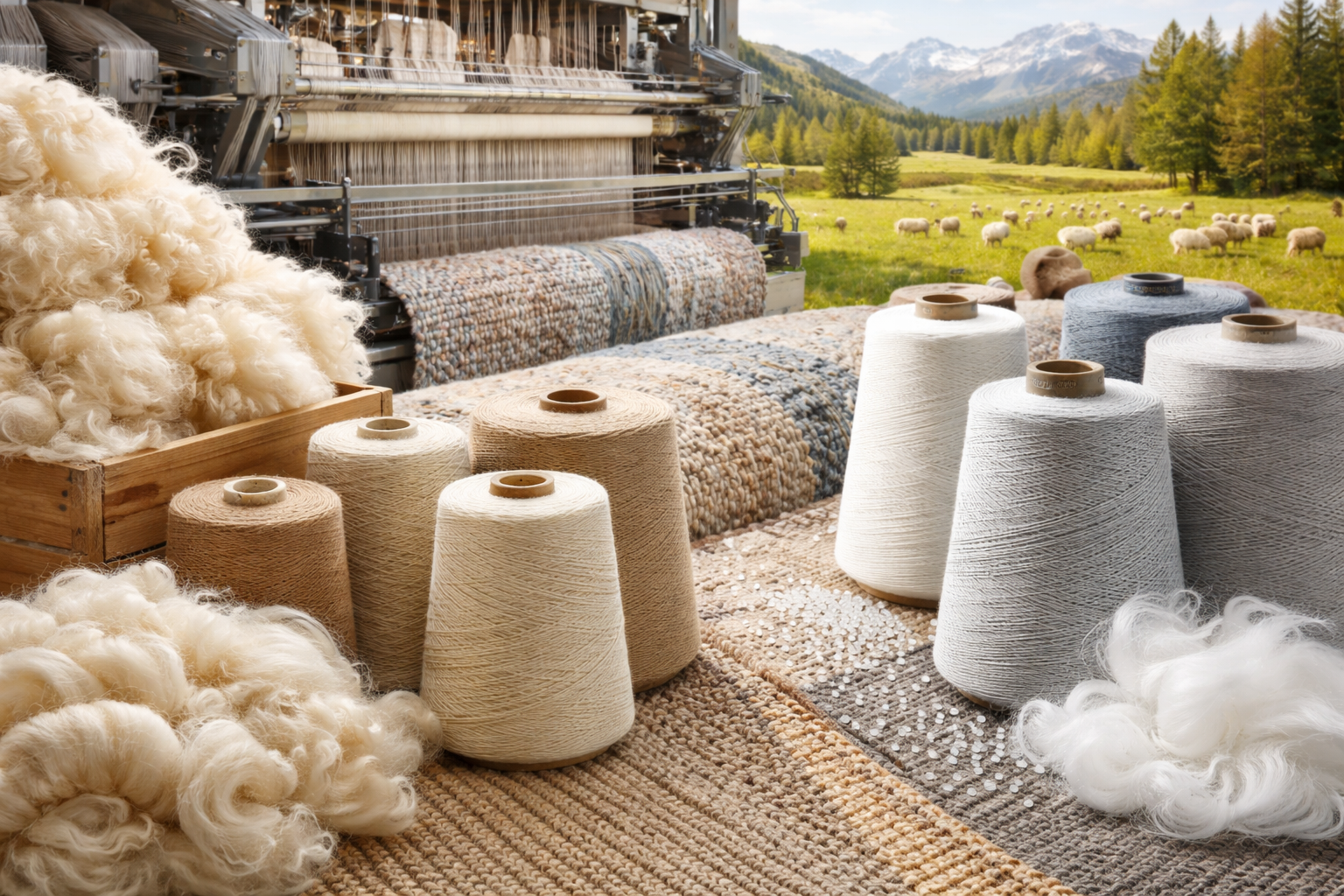
The result is an olefin-based yarn that’s been engineered with one specific purpose: to behave like wool should behave in an ideal world.
The texture is remarkably wool-like, not just visually, but tactilely. That plush, dense pile that customers associate with premium carpets? It’s there. The way it feels underfoot, the slight give, the warmth? All present.
But here’s where things get interesting from a manufacturing perspective.
When you run Woolino through your tufting machines, it cuts cleanly. Not “pretty well” or “better than other synthetics”—it cuts like a dream. The pile formation is consistent, the shearing process is straightforward, and once you’ve sheared it, that’s it. No continuous shedding. No fiber drifts. The carpet that leaves your facility is the carpet that stays on the floor.
This isn’t a small thing. It means fewer customer complaints, less warranty work, and customers who actually recommend your carpets to others instead of quietly dealing with lint rollers.
The European Context: Why This Matters Now
There’s a specific reason why Woolino is resonating with European manufacturers right now, and it has everything to do with where the industry is heading.
EPR regulations aren’t going away. If anything, they’re becoming more comprehensive. The Extended Producer Responsibility framework that came into full effect across the EU means manufacturers are now accountable for the entire lifecycle of their products—including end-of-life recycling and disposal.
Polypropylene (which forms the base of Woolino) has a clear recycling pathway. It’s Type 5 recyclable, with established collection and reprocessing systems. When a Woolino carpet reaches end-of-life in fifteen years, there’s a documented, compliant way to handle it. With natural wool, that pathway is far less clear—particularly for blended constructions.
Hypoallergenic certification is becoming a purchasing requirement, not a nice-to-have. Commercial projects—particularly in healthcare, education, and modern office environments, now commonly require documentation proving materials won’t trigger allergenic responses. Wool, by its nature, can’t provide that assurance. Woolino can.
Labor efficiency matters more than it used to. Not because European manufacturers are cutting corners, but because the skilled workers who know how to coax difficult materials through production processes are harder to find and more expensive to retain. A material that runs smoothly through existing equipment, requires less intervention, and produces consistent results simply makes better business sense.
What Production Managers Are Actually Seeing
The numbers that come back from facilities testing Woolino tend to be consistent, which is itself noteworthy.
Production time typically drops by 25-30% compared to natural wool processing. That’s not because anyone’s rushing, it’s because the material cooperates. Less time adjusting machines, less manual intervention during cutting, less finishing work needed after shearing.
Machine maintenance intervals extend. When you’re not running abrasive natural fibers through your equipment constantly, things last longer. Needles stay sharp, guides stay clean, tension systems need less frequent adjustment.
But perhaps most tellingly: quality rejection rates drop almost to zero. Not because standards are lowered, but because consistency improves. Every meter performs like every other meter. Every batch behaves like the previous batch. For quality control teams, this is transformative.
Here’s something manufacturers sometimes overlook: what happens after the carpet leaves your facility matters to your business.
When carpets shed continuously, customers notice. Maybe they don’t call immediately, but they remember. The next time they need flooring, they might choose differently. They definitely don’t recommend your product enthusiastically.
When carpets behave well, stay clean easily, don’t trigger allergies, maintain their appearance over years, customers remember that too. They become your marketing department. They specify your carpets for their next project. They tell facility managers and interior designers about their positive experience.
Woolino’s performance in real-world installations has been consistently strong. The absence of shedding means less maintenance for facility managers. The stain resistance inherent to polypropylene means carpets stay presentable longer. The durability means they handle high-traffic areas without showing wear patterns quickly.
These aren’t features that matter on specification sheets. They’re features that matter when someone decides whether to order from you again.
The Sustainability Conversation
Sustainability is complicated, and anyone claiming simple answers probably isn’t being entirely honest. Natural wool is renewable, yes, but it requires significant resources to produce, land, water, processing chemicals. Synthetic materials are petroleum-based, which carries its own environmental considerations.
What Woolino offers is a different calculation. The carpets last longer—often 40% longer than natural wool equivalents in comparable applications. Longer life means less frequent replacement, which means less total material consumed over time.
The production process generates less waste. The end-of-life recycling pathway is clearer. And in practical terms, the reduced maintenance required (less cleaning chemicals, less frequent deep cleaning, no moth protection treatments) means a lower environmental footprint during the use phase.
Is it a perfect solution? No material is. But it’s a more thoughtful one than the industry has traditionally had access to.
The European carpet industry is in an interesting moment. The old ways still work, but they’re becoming increasingly difficult to justify, economically, environmentally, and operationally. At the same time, customers aren’t willing to accept compromises on quality or aesthetics.
Materials like Woolino represent a pathway through this tension. They don’t ask manufacturers to choose between quality and practicality, between premium positioning and operational efficiency, between tradition and compliance.
They simply offer a more thoughtful option, one that respects both the craft of carpet making and the realities of modern manufacturing.
For European carpet makers considering their next decade of production, Woolino isn’t necessarily the only answer. But it’s certainly worth a serious look. The facilities that have tested it extensively tend to reach the same conclusion: it works, it works well, and it solves real problems without creating new ones.
In manufacturing, that’s about as good as it gets.
If you’re interested in evaluating Woolino for your facility, the process is straightforward. Sample packages are available for testing in your actual production environment. Technical documentation is comprehensive.
The manufacturers who’ve made the switch didn’t do it on faith. They did it on data, their own data, generated in their facilities, with their equipment, producing their products. That’s the only kind of data that really matters.
Woolino works. The question is whether it works for your specific situation, with your specific requirements, for your specific markets. There’s one way to find out.