A Reflection on the Global Carpet Industry’s Direction.
It’s a peculiar experience, walking through the halls of a global trade fair. Thousands of voices, hundreds of booths, countless conversations happening simultaneously, and yet, beneath the surface, a clear narrative emerges. This is the story of Heimtextile 2026, held in Frankfurt from January 13-16, and what it reveals about the future of the carpet industry, the relentless momentum toward sustainability, and the meaningful opportunities that lie ahead for innovators like Sparetex.
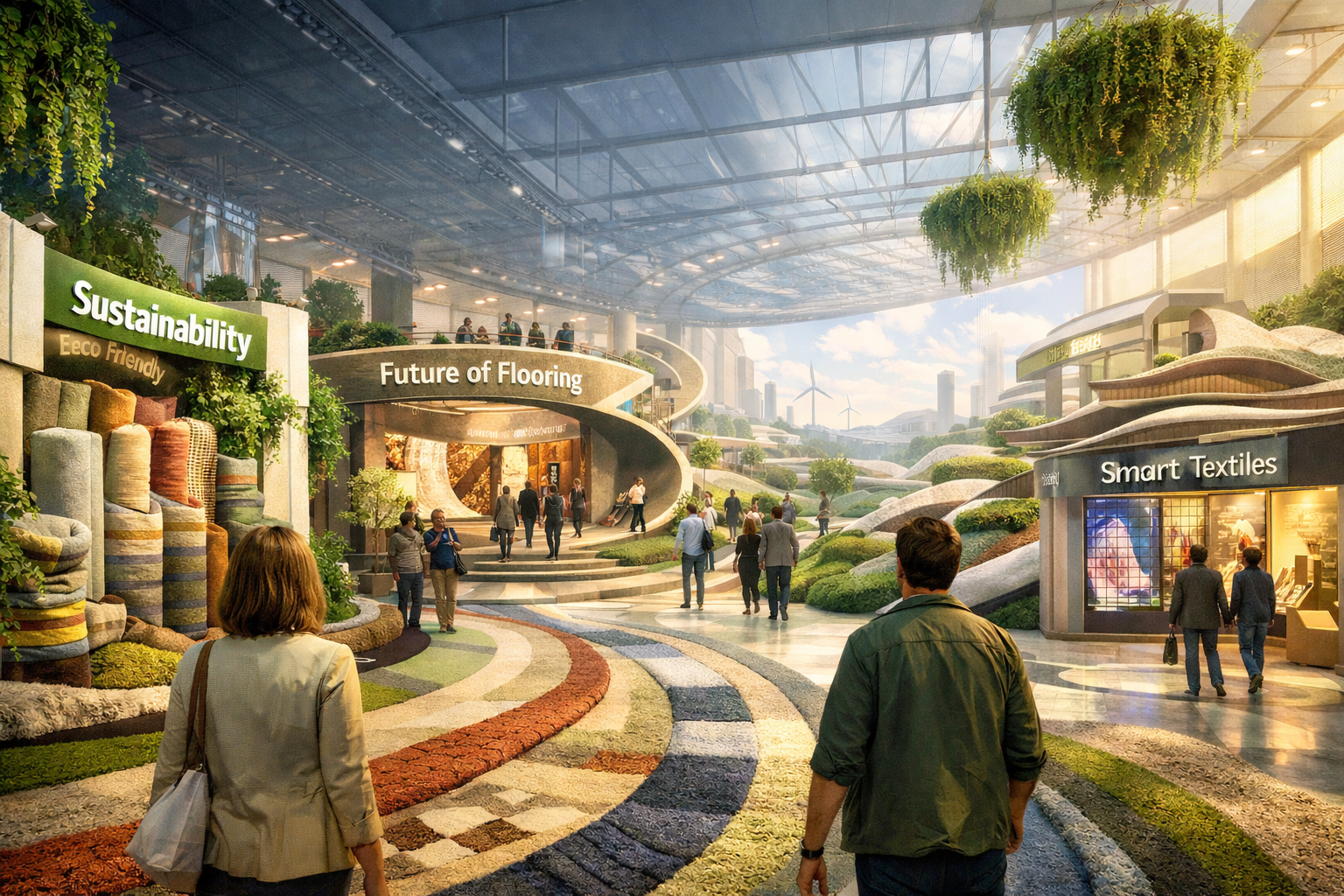
Heimtextile 2026 presented itself as something more ambitious than exhibitions past. The expanded Carpets & Rugs segment now spans four hall levels—11.0, 12.0, and beyond—a physical acknowledgment that textiles are no longer treated as secondary category but as a primary driver of industry conversation. The newly launched “Future Floor” arena in Hall 12.0 became, in many ways, the intellectual heart of the fair.
The fair’s scope was genuinely international. Indian handloom artisans shared floor space with German automation experts. Chinese manufacturers displayed sustainable innovations next to heritage carpet producers from the Middle East. This congregation created an unexpected intimacy despite the massive scale, a space where the global supply chain became visible, tangible, and deeply interconnected.
What impressed most visitors wasn’t the noise, but the quieter signal that emerged: sustainability has moved from being an aspirational nice-to-have to an operational baseline. When designers, architects, and procurement managers made purchasing decisions, they asked about carbon footprints before asking about colors. They evaluated circular economy credentials alongside aesthetic qualities. This shift wasn’t driven by marketing, it was driven by market necessity.
The 2026 Carpet Trends: Five Clear Signals
1. Sustainability as Non-Negotiable
The most striking observation across all of Heimtextile 2026 was the uniformity with which sustainability appeared not as a special feature but as a fundamental requirement. At DOMOTEX asia/CHINAFLOOR 2025, 68% of carpet exhibitors showcased sustainable products, and this momentum had clearly accelerated by January 2026.
Recycled polyester, recycled polypropylene with dissolution technology (like PureCycle’s innovations), and low-water manufacturing processes dominated conversations. Companies weren’t asking “should we be sustainable?” They were asking “how sustainable can we be while remaining competitive?”
Manufacturers were displaying carpets with 70% recycled content. Some had achieved closed-loop solutions where old carpets transformed into fiber-grade material for new production. The significance of this cannot be overstated, it represents a fundamental restructuring of production philosophy, from linear (extract → produce → discard) to circular (extract → produce → recycle → produce again).
2. Craft Merged with AI and Technology
The design platform Alcova and architect Patricia Urquiola’s “among-all” installation crystallized a theme that appeared throughout the fair: tradition and technology aren’t enemies—they’re partners.
Handloom carpets weren’t positioned as alternatives to machine-made products. Instead, they were celebrated as technologies in themselves, sophisticated, ancient technologies that could be informed by contemporary design thinking and digital tools. AI color generation was being used to enhance traditional weaving patterns. Digital design platforms helped artisans visualize complex compositions before investing labor. The result wasn’t mass production imitating craftsmanship, it was craftsmanship augmented by tools that respected both tradition and precision.
3. Natural Fibers Experiencing Renaissance (With Nuance)
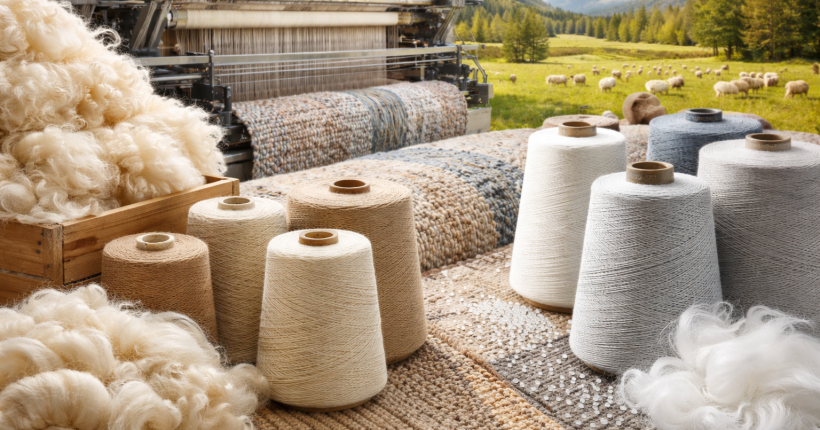
Jute, seagrass, sisal, and natural wool experienced renewed interest, but the conversation around them had matured. No longer was “natural” assumed to mean “better.” Instead, the market evaluated natural fibers alongside their trade-offs: water requirements, dye processes, durability characteristics, and lifecycle impact.
What emerged was sophistication: specifiers understood that wool’s hygroscopic properties and natural insulation made it ideal for certain applications, while engineered alternatives offered different advantages for different contexts. The revival of natural fiber carpets wasn’t a rejection of synthetics, it was an expansion of the palette, with each material evaluated on merit.
4. India’s Ascendant Role in Design and Sustainability Leadership
Indian manufacturers occupied a distinctive position at Heimtextile 2026. They weren’t competing primarily on cost anymore. Instead, they were competing on design sophistication, handcraft heritage, and increasingly, on sustainable material innovation.
Indian producers demonstrated hand-woven carpets made from reclaimed silk, sustainable jute blends, and innovative natural fiber combinations. More significantly, they had embraced technology, digital design tools, sustainable production practices, and supply chain transparency, without abandoning handcraft traditions. This synthesis positioned India not as a low-cost manufacturer but as an innovator navigating the intersection of heritage and modernity.
The Indian carpet industry is projected to maintain 5.6% CAGR through 2035, the highest growth rate globally, driven substantially by this capability to deliver sustainability, design innovation, and craftsmanship simultaneously.
5. Performance Became Inseparable from Aesthetics
High-traffic commercial environments increasingly demanded flooring that didn’t compromise on appearance for durability. This drove innovation in materials and construction—modular carpet tiles with 100% recycled polyamide, smart textiles embedded with health monitoring, and sophisticated fiber engineering that married visual richness with technical performance.
The market was no longer accepting the old bargain: beautiful but fragile, or durable but homely. Manufacturers were investing in solutions that delivered both.
The Sustainability Conversation: From Aspiration to Implementation
What Sustainability Actually Means Now
Sustainability in 2026 is specific and measurable. It’s not “we care about the environment.” It’s “our carpets are produced with 40% recycled content, water consumption reduced 60% through low-impact dyeing, backed by third-party EPD (Environmental Product Declaration), and accepted for take-back programs when end-of-life arrives.”
Companies like Interface and Tarkett have established protocols that verify these claims. The CQuest™Bio backing system, waterless and latex-free production methods, and dissolution recycling technologies represent genuine manufacturing innovation, not greenwashing, but actual systemic change.
The most mature expression of sustainability at Heimtextile 2026 was genuine circular thinking. Emerald Carpets partnered with PureCycle to establish carpet-to-carpet recycling using fiber-grade recycled polypropylene (rPP). Old event carpets collected from trade shows transform into purified pellets, which become fibers for new carpets. This creates accountability across the full lifecycle, manufacturers can no longer treat discarded products as someone else’s responsibility.
California’s requirements (beginning 2028) for carpet-to-carpet recycled content accelerated this trajectory. What began as regional regulation is becoming industry standard. Manufacturers who haven’t built circular capabilities into their operations are beginning to experience real market pressure.
Labor, Community, and Ethical Production
Beyond materials and processes, an equally significant conversation emerged around labor practices, artisan welfare, and community value creation. Speakers like Jutta Werner (Nomad) addressed ethical carpet design explicitly, raising questions about producer welfare, fair compensation, and cultural preservation.
This wasn’t abstract corporate responsibility. It was specific: How are artisans compensated? Are production communities supported? Is supply chain transparency documented? Are wages sufficient for dignified living? These conversations represented a maturation of the sustainability discussion beyond environmental metrics toward more complete social responsibility.
The Global Carpet Market: Direction and Scale
The global carpet market reached $62.90 billion USD in 2025 and is projected to reach $130.62 billion by 2033—a 9.59% CAGR. This growth is driven substantially by:
- Rising consumer spending on home and commercial interiors
- Construction booms in Asia and Europe
- Demand for sustainable, design-led flooring solutions
- Increasing specification of performance-oriented commercial carpets
- Digital transformation enabling customization and rapid production
Asia is leading this growth. India specifically, alongside Vietnam and Thailand, is experiencing accelerated export growth driven by sustainable product innovations and design capabilities. Vietnam’s sustainable jute carpet manufacturers increased export sales by 50% by connecting with European and North American buyers at trade shows focused on sustainability.
Where This Leaves the Future: Three Scenarios
Scenario 1: Commodity Pressure Continues
Lower-cost competitors will continue exerting margin pressure on volume segments. Polypropylene carpets produced with basic manufacturing won’t maintain pricing power. Manufacturers competing primarily on cost will face unrelenting pressure.
Scenario 2: Sustainability Becomes Baseline Compliance
Manufacturers who achieve sustainable production but fail to differentiate through design, performance, or artisan story will find sustainability insufficient to command market preference. Being sustainable won’t be enough, it will be table stakes.
Scenario 3: Innovation Drives Premium Positioning
Manufacturers who successfully merge sustainability, design innovation, performance engineering, and authentic storytelling will establish defensible market positions. Consumers willing to pay for quality increasingly demand these complete packages.
Sparetex’s Opportunity in This Landscape
Current Position: Embedded Strength
Sparetex brings several advantages into this evolving market:
Deep expertise in engineered fiber solutions: Seventeen years focused specifically on olefin yarn engineering gives Sparetex granular understanding of fiber behavior, performance characteristics, and application requirements. This isn’t generic yarn manufacturing, it’s deep specialization in materials that perform like premium natural fibers while delivering synthetic advantages.
Products aligned with market direction: Woolino, the wool-look engineered olefin fiber, directly addresses market demand for natural appearance with synthetic performance. Rouffino’s textured approach meets demand for design sophistication without premium natural fiber complexity. These aren’t legacy products, they’re deliberately engineered for 2026 market realities.
Geographic advantage in India’s ecosystem: Sparetex operates within the world’s most dynamic carpet manufacturing region. Direct connection to handloom artisans, power loom operators, and tufting facilities creates relationships and understanding that larger, diversified manufacturers can’t replicate. This proximity is competitive advantage.
Capability for customization: As market demand shifts toward design-led, performance-oriented solutions, manufacturers who can offer tailored specifications gain competitive advantage. Sparetex’s capability to customize denier ranges, color specifications, and performance characteristics positions it well for this trend.
Strategic Opportunities Moving Forward
1. Sustainable Content Leadership: While Sparetex’s current fibers are inherently stable and durable, the market is increasingly valuing recycled content and circular credentials. Exploring dissolution recycling partnerships (similar to PureCycle’s innovation with Emerald Carpets) could position Sparetex as offering not just high-performance fibers but sustainable high-performance fibers. This combination is increasingly rare and increasingly valued.
2. Design Collaboration: The design conversation at Heimtextile 2026 emphasized collaboration between fiber manufacturers, designers, and mills. Sparetex could position itself as partner to designers and manufacturers pursuing sophisticated, sustainable carpet collections—not just supplier of fiber, but collaborator in product development.
3. Artisan Enablement: Sparetex’s understanding of both handloom and machine applications positions it uniquely to support artisan communities pursuing design innovation and sustainable production. This aligns with market demand for ethical, craft-based products and plays into India’s distinctive capability.
4. Circular Economy Readiness: Building infrastructure and partnerships for take-back, recycling, and fiber recovery now positions Sparetex ahead of regulatory requirements and market expectations. The companies building these capabilities early will establish operational advantages competitors will struggle to replicate.
5. Global Design Narrative: Indian manufacturers are increasingly leading design conversation, not following it. Sparetex could invest in design collaboration, trends analysis, and global conversation to position its fibers not as commodity input but as innovation driver.
Heimtextile 2026 also revealed challenges that manufacturers cannot ignore.
Supply chain concentration risk remains real. While sourcing is diversifying (new exporters in Georgia, Poland, Sweden are emerging), geographic disruption still poses material risk. Climate events in India, tariff changes in major export markets, or labor challenges can rapidly shift competitive landscape.
Commodity margin compression isn’t ending. Volume competitors will continue finding ways to produce cheaper. The opportunity lies in segments willing to pay for differentiation, not in defending commodity positioning.
Sustainability compliance costs are rising. Achieving genuine circular economy credentials requires investment. Companies that treat sustainability as marketing will eventually face accountability. Genuine commitment requires sustained capital allocation.
Labor challenges in handmade production persist. While artisan craftsmanship is valued, the labor required to produce handwoven carpets at scale is increasingly difficult. Mechanization offers efficiency but challenges the authenticity that commands premium pricing.
Closing Reflection: The Fair as Mirror
Trade fairs reveal not the future, but the present moment’s aspirations and anxieties. Heimtextile 2026 showed an industry that understands itself to be in transition. The old model, produce volume at lowest cost, optimize for price-sensitive buyers, is no longer dominant. The emerging model emphasizes design, sustainability, authenticity, and lifecycle accountability.
This transition favors manufacturers with design capability, sustainability infrastructure, and embedded relationships with customers. It challenges commodity producers and those treating sustainability as optional.
For Sparetex, the fair suggested that the path forward isn’t through becoming cheaper, but through becoming more valued, through demonstrating that engineered fibers can deliver both aesthetic sophistication and environmental responsibility, that synthetic materials can partner with traditional craftsmanship, that deep specialization in fiber science creates advantages that commodity manufacturing cannot match.
The future of carpets will be written by manufacturers who understand that sustainability and quality are no longer separate objectives. They’re the same objective viewed through different angles. It will be written by those who see technology not as threatening tradition but as tool that honors it. It will be written by those who recognize that consumers increasingly value complete stories—beautiful products, responsibly produced, backed by transparent supply chains and genuine commitment to both environmental and social responsibility.
Sparetex, by its nature and positioning, is well-positioned to be part of writing that story.